
Why do speakers that handle speech and podcasts with perfect clarity so often disappoint with music? The question came up in a team conversation sparked by something unexpected. One of us has been closely observing someone living with a cochlear implant — a device that works remarkably well for speech. Face-to-face conversations, meetings, everyday interactions: the clarity is genuinely impressive. But put on music and something breaks down entirely. Not a malfunction — a design reality. A cochlear implant processes sound through a set of frequency channels, and it handles speech well because speech is largely one voice, one fundamental tone at a time. Music is the opposite: multiple instruments producing dozens of simultaneous frequencies that flood those channels at once. The device can’t separate them cleanly. The result is that music doesn’t sound like music at all. It arrives as broad noise.
That conversation planted a thought about room acoustics and speaker systems. What a cochlear implant does to music in the extreme, a living room does in a subtler but structurally related way. A room with premium speakers doesn’t reduce music to noise — but it routinely fails to deliver music the way you expect to hear it. The experiences are very different. The underlying reason is not.
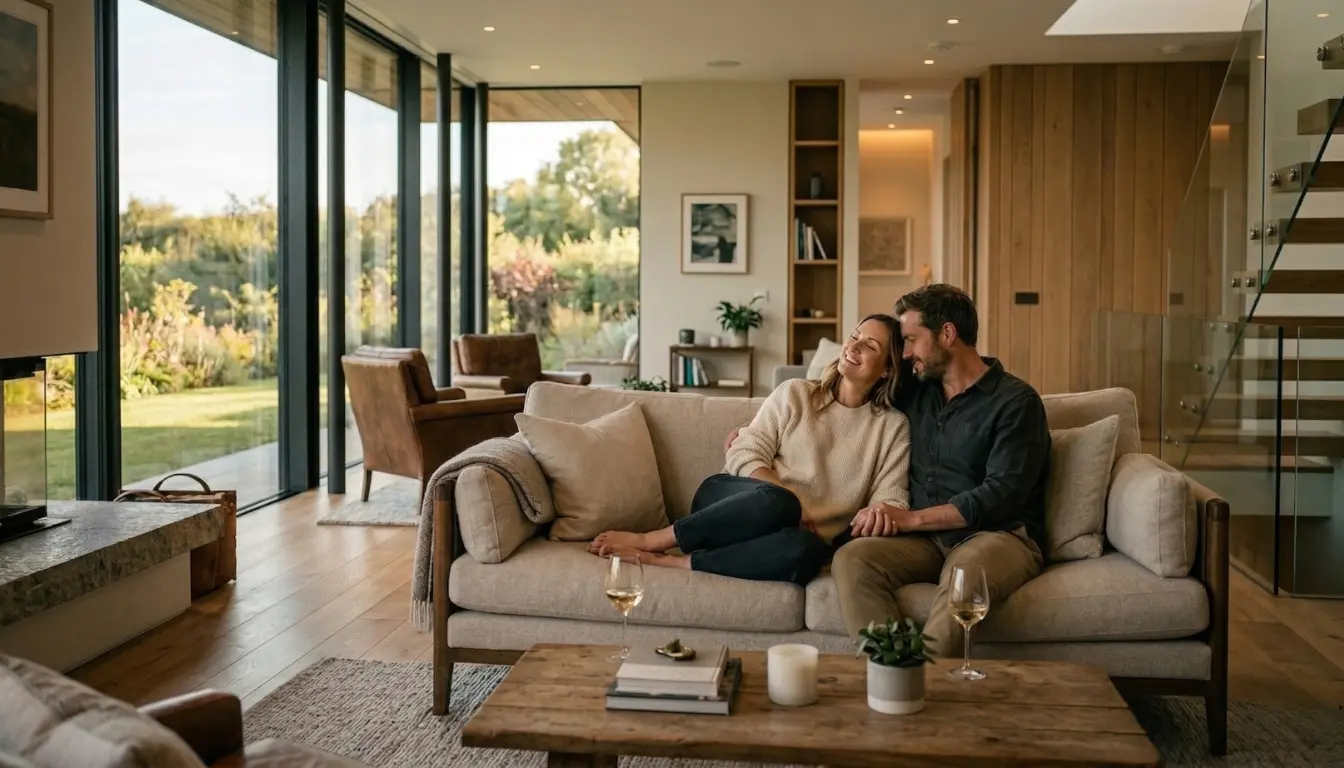
You put on a podcast in the living room and every word comes through clearly — no effort, no adjustment, no complaints. Then you switch to your favorite album and something feels off. The bass is boomy in some spots and thin in others. The vocals feel buried behind the mix. The whole track sounds muddy in a way that has nothing to do with the recording quality you know is there. Same speakers. Same room. Same volume. Completely different result.
This is one of the most common — and most misunderstood — frustrations homeowners bring to us. The instinct is to blame the speakers or the streaming quality. Neither is usually the problem. The room is the problem. Speech and music make fundamentally different acoustic demands, and most living rooms only satisfy the easier one. This article explains three reasons why music is dramatically harder to reproduce in a room than speech — and what that means for anyone who wants speakers that actually perform the way they should.
How Speech and Music Differ as Sound
The human voice operates within a surprisingly narrow frequency band — roughly 300 to 4,000 Hz covers the range essential for speech intelligibility. Music spans the full audible spectrum from 20 to 20,000 Hz, a range more than ten times wider. That difference alone explains a great deal, but frequency range is only part of the story.
Speech is essentially monophonic: one voice producing one fundamental pitch with harmonics at any given moment. Music is polyphonic — multiple instruments and voices producing dozens of simultaneous frequencies, each with their own harmonic overtones. A kick drum, a bass guitar, a piano chord, and a vocal melody all occupy the room at once, each competing for the same acoustic space. Speech also operates within a relatively compressed dynamic range; music swings from delicate pianissimo passages to full-force fortissimo, demanding that a system handle enormous variation without distortion or collapse.
A room that handles the narrow, simple signal of speech can fail completely when asked to handle the wide, complex signal of music. Speech is one car on a highway — easy to manage regardless of road conditions. Music is rush-hour traffic with vehicles of every size and speed; the highway’s design flaws become impossible to ignore.
With this distinction in place, the first and most impactful challenge comes from the bottom of the frequency spectrum.
The Bass Problem: Where Rooms Fight Back
Why Low Frequencies Are Uncontrollable in Most Rooms
Speech barely touches bass frequencies. The lowest male voice fundamentals sit around 85–90 Hz, and intelligibility requires nothing below 300 Hz. Music reaches down to 20–80 Hz — bass guitars, kick drums, cellos, synthesizers, pipe organs. These frequencies carry the physical weight and emotional presence that defines how music feels in a room.
The complication is physical. Bass wavelengths are enormous: a 60 Hz wave measures roughly 19 feet (5.7 meters) from peak to peak. In a residential room, those wavelengths are comparable to the room’s own dimensions — which creates a phenomenon called standing waves (room modes), where bass frequencies reflect back on themselves and reinforce into fixed patterns of unevenness throughout the space.
Standing Waves: The Invisible Distortion
Standing waves occur when a sound wave’s wavelength fits a room dimension closely enough to reflect and reinforce itself, creating fixed zones of excess loudness and near-silence. Research on standard rectangular rooms documents bass peaks and dips of up to 10 dB from physical placement alone — and real-world installations in luxury homes with hard surfaces, high ceilings, and open floor plans regularly exceed these averages. Linkwitz Lab’s room acoustics research documents approximately 375 discrete room modes below 300 Hz in a typical domestic-size listening room, meaning 375 different frequencies where the room has an acoustic opinion that overrides what your speakers are trying to deliver.
The subjective experience is familiar: one seat sounds boomy, the one next to it sounds thin, and certain bass notes boom unnaturally while others disappear. None of this reflects the speakers’ quality — it is the room’s geometry interacting with physics. Speech avoids all of it because speech rarely reaches the frequencies where these modes operate.
Why Treatment Is Impractical Without Professional Design
Acoustic treatment for bass requires absorbers roughly one-quarter wavelength deep. For a 60 Hz problem, that means nearly five feet of absorptive material. Installing five-foot-deep bass traps in a luxury living room is not a realistic option, and standard acoustic foam does nothing at these frequencies. The practical solution is different: strategic speaker placement that avoids exciting the worst room modes, combined with DSP (Digital Signal Processing) calibration that measures the room’s acoustic signature and compensates electronically. This is why room-aware system design matters — it works with the physics rather than fighting them with interior design sacrifices.
Bass management is only the first challenge. Music also creates a problem that speech never triggers: the collision of too many sounds competing in the same acoustic space at once.
The Polyphony Problem: When Sounds Mask Each Other
One Voice vs. an Orchestra
A speech signal is one sound source at a time — a voice with a predictable frequency signature that a room can process without ambiguity. Music layers instruments simultaneously: vocals, guitar, bass, drums, keys — each generating its own fundamental frequencies plus harmonics that spread across the spectrum. In a well-designed recording studio, these layers are carefully separated through acoustic isolation, strategic microphone placement, and mixing. In a living room, the room’s reflections and resonances smear those layers back together.
Frequency Masking: Sounds That Erase Each Other
Frequency masking is the perceptual erasure of quieter sounds by louder ones that share the same frequency range. When two sounds occupy overlapping frequencies simultaneously, the louder one renders the quieter one inaudible. Common masking pairs in music are well-documented: vocals and piano both occupy the 250–4,000 Hz range; bass guitar and kick drum both live below 200 Hz. In a room with excessive reflections, masking worsens because reflected sound energy piles onto direct sound, widening the masking effect beyond what the recording itself contains.
The result is music that loses definition and clarity — a wall of sound rather than distinct instruments. Voices feel buried in the mix not because the recording is poor but because the room has added a layer of reflected energy that the ear’s masking threshold cannot separate.
Constructive and Destructive Interference
When multiple simultaneous frequencies bounce off walls and hard surfaces, some reflections arrive back at the listening position in phase with the original signal — constructive interference, which adds loudness — and some arrive out of phase, producing cancellation. With speech, this occurs across a narrow frequency band and produces barely noticeable coloration. With music, it happens across thousands of frequencies simultaneously, creating an uneven sonic character that shifts depending on exactly where you sit in the room.
This is why the same track can sound noticeably different from two seats three feet apart. And it is why treating it as a speaker problem leads to increasingly expensive hardware purchases that change nothing fundamental about the room’s acoustic behavior.
The polyphony problem concerns how the room processes simultaneous sound. The third challenge is about time — specifically, how long sound lingers after it leaves the speakers.
The Reverberation Mismatch: Your Room Can’t Serve Two Masters
What Reverberation Time Means for Your Living Room
Reverberation time — expressed as RT60 — is the time it takes for sound to decay by 60 dB after the source stops, effectively measuring how long sound lingers in a room. Speech needs short reverberation, typically 0.4–0.6 seconds, to maintain syllable clarity; longer decay blurs consonants and makes words harder to follow. Music behaves differently. It benefits from reverberation times in the range of 1.0–2.0 seconds, which add warmth, fullness, and the sense of space that makes a recording feel alive. Concert halls are specifically designed around these longer decay times.
Most furnished living rooms fall around 0.5–0.8 seconds naturally — acceptable for conversation, but too dry for music to breathe properly. Architectural acoustics research from CertainTeed shows that an unfurnished open-plan space of 1,000 square feet with 12-foot ceilings and hard surfaces can produce an RT60 of 3.2 seconds — far too long for either speech or music, and representative of what many Bay Area homes present before furniture and finishes are added.
The Multipurpose Room Compromise
A room optimized for conversation would use heavy absorption — rugs, curtains, upholstered furniture — to keep reverberation short and maintain speech clarity. A room optimized for music would balance absorption with diffusion, incorporating hard surfaces and varied geometry that allow sound to breathe without collecting into destructive reflections. Most luxury homes land somewhere between these extremes by accident rather than design: open floor plans with hardwood floors, glass walls, soft furniture, and high ceilings produce a reverberation character that serves neither speech nor music particularly well.
Without deliberate acoustic design, the room’s reverberation is whatever the architectural and interior choices happened to create — and those choices were made for aesthetics, not acoustics.
Why This Matters for Speaker-Based Playback
Unlike a live musician who adjusts performance dynamics to the room in real time, speakers deliver a fixed signal. The room’s reverberation either supports or undermines playback with no adaptation on its own. Modern DSP-equipped systems can partially compensate when calibrated specifically to the room’s measured acoustic profile, adjusting output to counteract the room’s reverberation character and bring music reproduction closer to the engineer’s original intent. For critical HiFi listening rooms, a target RT60 of 0.5 seconds is generally recommended — achievable through a combination of speaker placement, calibration, and thoughtful use of the room’s existing surfaces.
Understanding these three challenges — bass management, polyphony interference, and reverberation mismatch — reframes the core question from “which speakers should I buy?” to “how should my system be designed for this room?”
What This Means for Your Home Audio Setup
Why Better Speakers Alone Won’t Fix It
Upgrading from a consumer soundbar to a premium speaker system typically makes every room problem more audible, not less. High-end speakers are engineered for accuracy — they reproduce what they receive with greater fidelity, including every artifact that room acoustics introduce. A $500 soundbar softens these problems through its own limitations; a $5,000 speaker system reveals them in detail. The complaint that speakers sound flat or disappointing in a living room is almost always a room problem wearing a speaker-shaped disguise.
The Professional Approach: Room-Aware System Design
Solving the acoustic mismatch between a living room and music reproduction requires treating speaker selection, placement, calibration, and room interaction as one integrated system rather than independent decisions. Speaker placement relative to room boundaries determines which modes are excited and how direct sound relates to early reflections. Subwoofer positioning — often counterintuitive, since corners are not always the optimal choice — shapes bass distribution across the full listening area. DSP calibration tailored to the room’s measured signature corrects for both standing wave problems below 300 Hz and reverberation characteristics throughout the rest of the spectrum. Strategic use of existing room features — rugs, bookshelves, furniture arrangement, soft furnishings — can contribute meaningfully to acoustic behavior without visible treatment panels or architectural changes.
For homeowners in the Bay Area with open floor plans, high ceilings, and expectations that match their investment in hardware, this kind of integrated approach is what separates a system that looks impressive from one that performs the way it should. You can explore what that process looks like through our home audio solutions.
With this foundation in place, let’s address the questions homeowners ask most often.
Common Questions About Room Acoustics and Music Playback
Why do my speakers sound great for podcasts and calls but flat when I play music?
Speech operates within a narrow frequency band (300–4,000 Hz) that most rooms handle without significant problems. Music spans the full audible spectrum (20–20,000 Hz), exposing room acoustic challenges — especially in the bass range — that speech never triggers. Add the complexity of multiple simultaneous instruments creating masking and interference, and the gap between speech clarity and music quality becomes audible even through identical speakers in the same room.
Does room shape affect music playback more than speech?
Room dimensions determine which bass frequencies create standing waves — zones of pronounced loudness and near-silence that shift depending on where you sit. Speech avoids the low frequencies where these modes are most severe, so room shape has minimal effect on conversation clarity. Music’s bass content interacts directly with room dimensions, making proportions and volume critical factors in sound quality rather than background variables.
Can speaker placement alone fix how music sounds in my living room?
Speaker placement is the single most impactful variable — it determines which room modes are excited and how direct sound relates to early reflections. Placement alone cannot solve every problem, but it forms the foundation of any professional installation. Optimized placement combined with DSP calibration and, where appropriate, targeted acoustic management addresses all three challenges: bass distribution, masking reduction, and reverberation control. The sequence matters: start with placement, then calibrate, then assess what further treatment adds.
What is the acoustic difference between a speech room and a music room?
A speech room requires short reverberation time — typically 0.4–0.6 seconds — to preserve syllable intelligibility without overlapping echoes. A music room benefits from longer decay, 1.0–2.0 seconds depending on genre and preference, which provides acoustic warmth and a sense of space. Most living rooms fall into neither category by design, landing at an accidental compromise that serves both purposes imperfectly.
Why does my room make music sound muddy but speech sounds fine?
Music spans a much wider frequency range than speech, particularly in the bass region where untreated room modes cause the most pronounced acoustic distortion. Speech avoids the problematic frequencies below 300 Hz where standing waves are strongest, allowing most rooms to handle conversation cleanly. Music’s bass content triggers these resonances directly, and the polyphonic signal compounds the problem through masking and interference that a single voice never creates.
Three Reasons, One Solution: Design the System Around the Room
The podcast sounds perfect and the music disappoints because speech and music are fundamentally different acoustic problems. Speech is narrow-band, monophonic, and forgiving of reverberation — most rooms handle it adequately by accident. Music is full-spectrum, polyphonic, and sensitive to every acoustic variable: bass management, frequency masking, and reverberation balance all compound each other in ways that premium hardware alone cannot resolve.
The most common mistake is treating audio quality as a hardware procurement problem. Better speakers in the wrong acoustic context amplify the room’s shortcomings rather than eliminating them. The solution is a system designed around the specific characteristics of the space — speaker placement that works with room geometry, DSP calibration matched to the room’s measured behavior, and thoughtful use of the room’s existing surfaces as part of the acoustic equation.
For a Bay Area home with an open floor plan and expectations that match the investment, this is not an optional refinement. It is the difference between equipment that technically works and a listening experience that actually delivers. An acoustic assessment is the right starting point: it reveals exactly what your room does to sound, and what it takes to align the system with how the music is meant to be heard.